Small research nodes, large questions
An ambitious research question does not always need an ambitious language model at every step. Often it needs many small, well-chosen calculations—and a reliable way to learn from what they return.
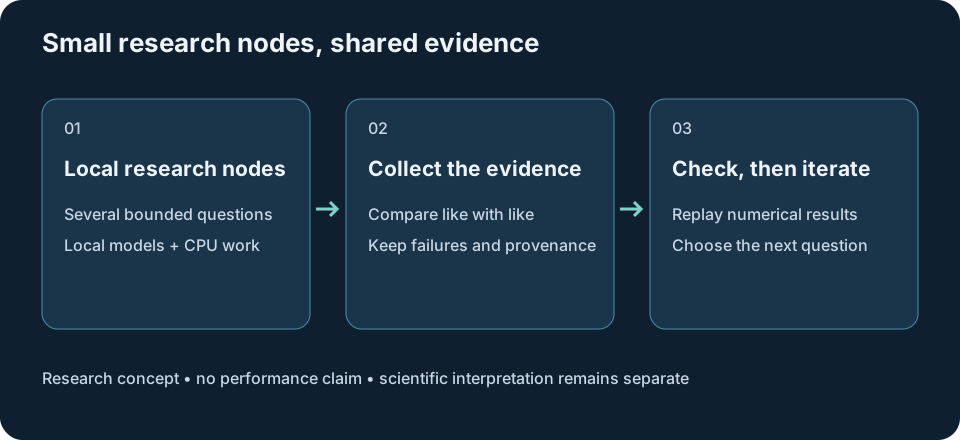
We are exploring a variant of the research workflow around RIFT, in which each computational node has a modest local language model and a bounded experimental assignment. Nodes would propose and carry out small investigations in parallel, then return evidence to a shared collection step. The collection should consolidate what was tested, what failed, and what remains uncertain.
Put scarce compute where it matters
A local model would help choose an experiment and interpret its documented outcome. Numerical software would carry out the calculation. That separation makes limited hardware an interesting design constraint: model inference can be brief, while conventional calculations occupy the available CPU workers. Parallel research nodes need not mean several large language models competing for the same small GPU.
The scientific opportunity is directed exploration of physics-based model spaces. A collection of nodes could investigate different constrained questions, rather than repeatedly elaborating the same plausible explanation. Their reports must remain comparable; an eloquent description is not a measurement.
Collection is part of the science
A useful collection step must retain unsuccessful experiments, provenance, and the limits of every comparison. It should distinguish new evidence from a duplicate calculation and a successful numerical test from a scientific conclusion. Independent checks must be able to replay a result without trusting the agent’s account of it.
This connects directly to our publication and verification objective. If agents help conduct research, they need a bounded way to publish inspectable records and a separate way to verify the records they consume.
A direction to test
This is a research proposal. A small numerical prototype is the starting point, not evidence that autonomous nodes improve scientific discovery. The decisive comparisons will be against ordinary search strategies under matched computational budgets, with held-out tests and independent reproduction. Details of the experimental design are being developed in a separate working paper.
The goal is practical: make modest resources produce a more useful, inspectable body of experiments—and learn when the agents add value.